
🌍 TODAY’S STRATEGIC PRAYER FOCUS
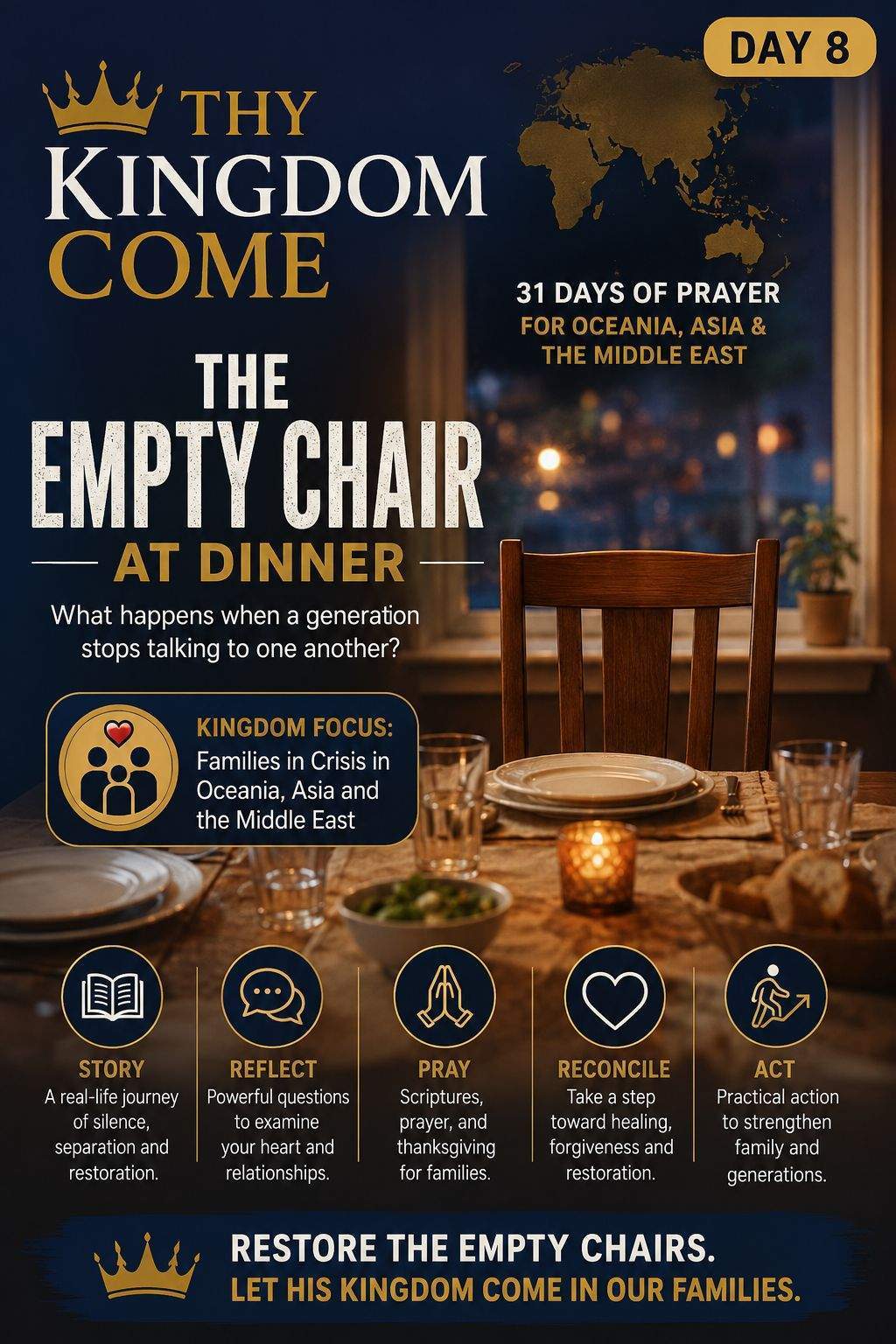
DAY 8 – THE EMPTY CHAIR AT DINNER
📚 Resources
🙏 Prayer 4 Nations
https://movement.otakada.org/pray4nations
📖 366 Days DBS
https://movement.otakada.org/366daysdbs
🌍 Access Ministry
https://movement.otakada.org/accessministry
🎓 Movement Training
https://movement.otakada.org/training
🧩 Spiritual Gifts Test
https://movement.otakada.org/l/p/spiritual-gift-test
🏠 Movement Home
https://movement.otakada.org
📱 Google Play Books
https://play.google.com/store/books/details?id=1z3vEQAAQBAJ
━━━━━━━━━━━━━━━
👑 Theme: Thy Kingdom Come
🌏 Kingdom Focus: Families in Crisis in Oceania, Asia & the Middle East
❓ Big Question: What happens when a generation stops talking to one another?
🪑 The Empty Chair at Dinner
Pray4Nations
Prayer Fuel for Nations
🌍 DAY 8 – The Empty Chair at Dinner

Theme – Thy Kingdom Come
Kingdom Focus: Families in Crisis in Oceania, Asia and the Middle East
Big Question: What happens when a generation stops talking to one another?
The chair had been empty for almost three years.
Every evening at precisely seven o’clock, Margaret still set the table for five people even though only four lived in the house. Her husband had stopped mentioning it long ago. Their younger daughter noticed but never asked why. Visitors occasionally assumed they were expecting company. Nobody realised that the empty chair belonged to someone who had once occupied it every day.
His name was Daniel.
The chair stood at the far end of the table near the window overlooking the street. For years it had been his place. As a child he used to swing back and forth on its rear legs despite repeated warnings from his parents. During his teenage years it became the place where he shared stories about school, sports, friendships, and dreams for the future. Family photographs taken around birthdays, holidays, and celebrations often showed Daniel sitting there, smiling broadly while everyone else laughed around him.
Now the chair remained untouched.
At first glance, the family appeared successful. They lived in a growing city that had benefited from years of economic development. Their home was comfortable. Their children attended good schools. Their needs were met. Friends often described them as blessed.
Yet beneath the surface, something had broken.
The fracture did not happen overnight. Looking back, Margaret often struggled to identify the exact moment things began changing. There had been no dramatic argument, no single act of rebellion, and no obvious crisis. Instead, distance arrived quietly.
It began with schedules.
Daniel became busier at school. His father spent longer hours at work. Margaret became involved in community projects and church activities. Family meals gradually became less frequent. Some evenings one person arrived late. Other nights someone ate elsewhere. Weekends disappeared beneath commitments, appointments, activities, and obligations.
Without anyone noticing, conversations became shorter.
The family still lived in the same house.
They simply stopped sharing life together.
Technology accelerated the process.
Phones appeared at the table. Earphones became permanent accessories. Messages replaced conversations. Family members occupied the same room while living in separate worlds. Everyone remained connected to thousands of people and disconnected from those closest to them.
Margaret remembered one evening when all four family members sat together in the living room. The television was off. Nobody was speaking. Yet each person was staring at a screen. The silence felt strangely heavy.
She wanted to say something.
She never did.
As Daniel entered his final years of secondary school, deeper questions emerged. He wanted to discuss purpose, faith, identity, relationships, and the future. He needed guidance. He needed conversations. He needed someone willing to listen without immediately correcting, judging, or dismissing him.
Instead, most discussions turned into lectures.
When he expressed uncertainty, people offered instructions.
When he shared concerns, people offered solutions.
When he raised difficult questions, people changed the subject.
Gradually, he stopped talking.
Margaret did not recognise the warning signs at first. Parents often assume silence means everything is fine. Sometimes silence means the opposite.
By the time Daniel left for university, the emotional distance already felt enormous. Phone calls became less frequent. Messages grew shorter. Visits home became rare. Family gatherings felt awkward, as though everyone was trying to reconnect with someone they no longer fully understood.
Then came the argument.
Ironically, the argument itself was not especially important. Years later nobody could remember exactly what started it. What mattered was everything hiding beneath it. Unspoken disappointments. Unasked questions. Unexpressed fears. Expectations never discussed. Wounds never addressed.
Words were spoken.
Doors were closed.
And eventually Daniel left.
Months passed.
Then years.
The family continued functioning. Birthdays came and went. Holidays arrived. Life moved forward. Yet the empty chair remained.
One Sunday, after a church service focused on reconciliation, Margaret found herself unable to leave. As people gathered outside, she remained seated quietly near the back of the sanctuary.
An elderly woman eventually sat beside her.
“You look troubled,” she said gently.
Margaret smiled weakly.
“My son hasn’t spoken to us properly in years.”
The older woman listened without interrupting.
When Margaret finished, she expected advice.
Instead, the woman asked a question.
“When was the last time you listened to him without trying to fix him?”
The question landed heavily.
Margaret wanted to answer immediately.
She couldn’t.
For several days the question followed her everywhere. She replayed years of conversations in her mind. Slowly she began recognising something she had never seen before. Her family had become skilled at speaking but poor at listening.
Several weeks later she sent Daniel a message.
It contained no advice.
No correction.
No defence.
Only four words.
“Help me understand you.”
There was no immediate reply.
Days passed.
Then one evening a message appeared.
It was longer than anything Daniel had written in years.
The healing did not happen overnight.
Trust rarely returns that quickly.
But conversations slowly resumed.
Phone calls followed.
Visits became possible again.
One evening, nearly three years after he left, Daniel walked through the front door carrying a small travel bag.
Margaret tried to remain composed.
She failed.
When dinner began that night, nobody paid much attention to the food. The conversation mattered more. There were still issues to address. Questions remained. Healing was not complete.
Yet something had changed.
The chair was no longer empty.
And perhaps that is where restoration often begins.
Not with perfect answers.
Not with winning arguments.
But with people choosing to listen again.
Across Oceania, Asia, and the Middle East, millions of families are facing similar challenges. Generations live under the same roof yet struggle to understand one another. Technology connects people globally while isolating them locally. Parents and children often share space but not conversation.
The empty chairs may look different from family to family.
But they exist.
The question is whether we will notice them before they remain empty too long.
📖 Theme Scriptures
• Malachi 4:6
• Ephesians 6:1–4
• Colossians 3:13–14
🤔 Pause & Reflect
• What part of the story touched you most?
• Is there a family relationship that needs healing?
• When did you last listen without trying to fix someone?
• Is there an “empty chair” in your family or community?
• What step of reconciliation is God asking you to take?
🙏 Thank God For
• Families who continue to love and support one another.
• Parents, grandparents and caregivers investing in the next generation.
• Stories of reconciliation and restoration.
• God’s power to heal broken relationships.
• His grace that no family is beyond redemption.
❤️ What Is God Saying to You?
• Who needs understanding more than advice?
• Is there a conversation you’ve been avoiding?
• Where do you need to forgive or seek forgiveness?
• What legacy are you leaving for the next generation?
🚶 Action Step
Reach out to one family member this week.
Listen intentionally.
Ask thoughtful questions.
Seek understanding before offering advice.
Take one practical step toward restoring or strengthening your relationship.
✍️ My Action Step: ______________________
🙏 Prayer
Father, we lift before You the families of Oceania, Asia and the Middle East. Heal broken relationships, restore communication and turn hearts toward one another. Strengthen marriages, encourage parents, guide children and comfort those carrying pain, loneliness and disappointment.
Teach us to listen with humility, forgive generously and pursue reconciliation. Let our homes become places of peace, discipleship, love and belonging. Restore the empty chairs and rebuild what has been broken.
May Your Kingdom come in our families and through our families.
In Jesus’ mighty name. Amen.
🗣️ Declaration
Today I choose reconciliation over division and understanding over assumption.
By God’s grace, I will invest in my family relationships, listen with compassion and become a source of healing, encouragement and peace.
📊 Journal Today
• What did God say to you?
• What action will you take?
• Who will you share this lesson with?
🌍 Connected Kingdom Resources
Grow. Train. Pray. Discover Your Calling. Stay connected with the movement.