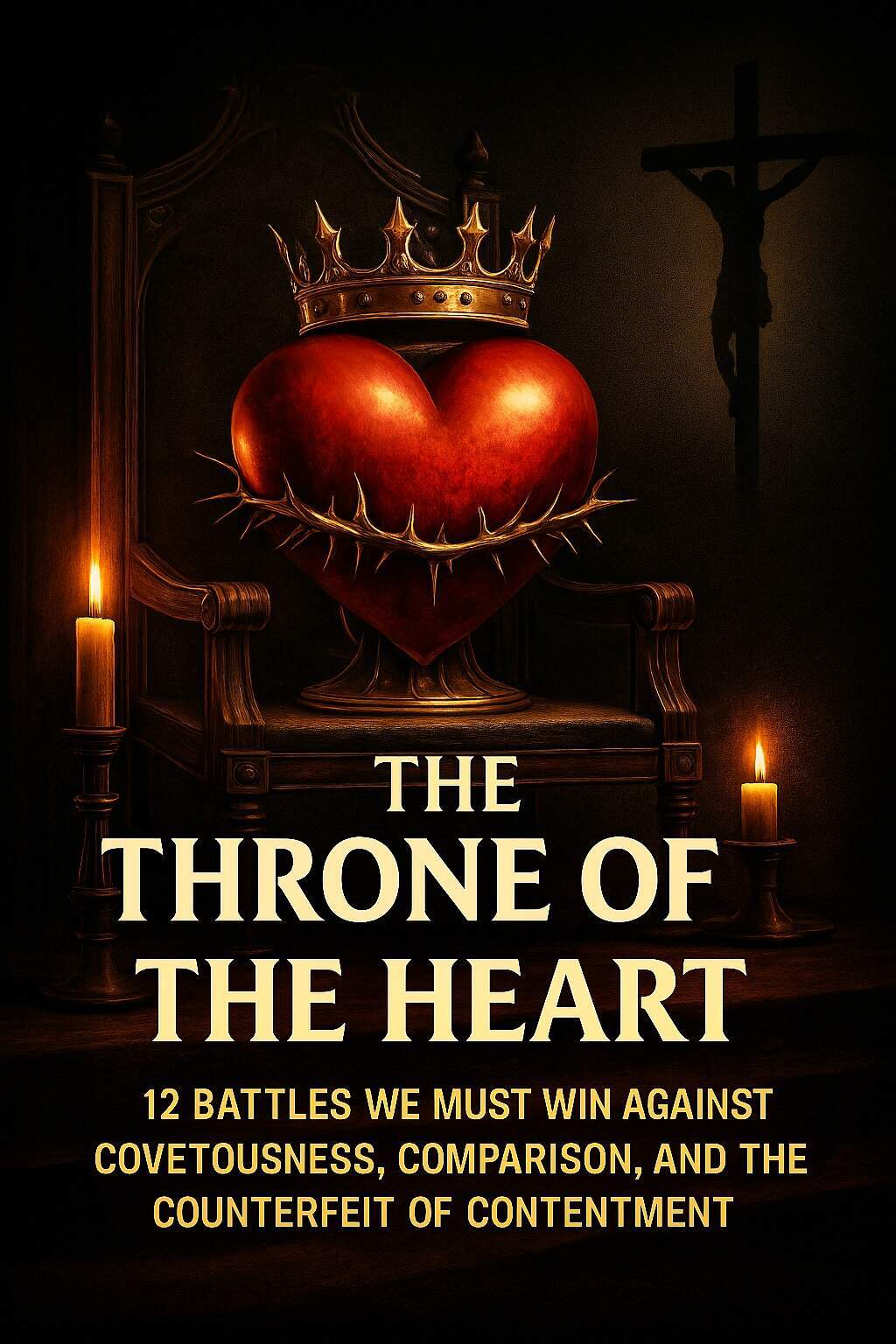
The throne of the heart: 12 battles We Must WIN Against COVETOUSNESS, COMPARISON, and the Counterfeit of CONTENTMENT
Friday, NOVEMBER 28TH, 2025
YOUTUBE LINK – https://youtu.be/pfdffNNGH-s?si=xCPctwBOpKTZGSK0
PODCAST LINK – https://open.spotify.com/episode/0KDztlNO6y2Ze8lPIIUxKA?si=PG2SFbUpQMGhsmRaqhkHuQ
Friends, this message took more than 30 days in preparation, meditation, self confrontation, repentance and obedience so that the delivery of this message to you will bear relevance that will lead to godly repentance and lasting transformation in us all.
As you listen, meditate, don’t ignore the mirror that you see but do something about it because the greatest rejoicing that takes place in heaven is when there is genuine repentance from we the earthlings! Luke 15:7
Prophet Samuel told Saul that obedience to Gods command is better than sacrifice – 1 Samuel 15:22
And occurs in 56 other scriptures throughout Bible. There is no point offering thanksgiving that is not the genuine article.
In less than 24 hours, AND into the rest of the year, many will be offering their thanksgiving to God! The only thanksgiving God accepts is one that comes from deep within us and done in obedience.
Godliness, Contentment, and Covetousness are BIG ticket words throughout Scripture, and we will do well to search our hearts just like David cried out in Psalm 139:23:
“Search me, O God, and know my heart…”
God desires to work with authentic vessels, clean vessels, not hypocritical, pretentious actors. He is looking for men and women whose lives of thanksgiving flow from obedience, not performance.
This teaching will be the last message for the year, except the Holy Spirit instructs otherwise.
By God’s grace, we will be converting these teachings into books and films, translated into different languages for a larger audience worldwide. We will also be starting radio broadcasts to reach offline listeners who may never find us on the internet but whose hearts are hungry for truth.
❤️ A CALL TO PARTNERSHIP
If these messages have been a blessing to you, I would like you to prayerfully consider partnering with us so we can take them further—onto radio, film, books, and multiple media platforms—for a deeper, transformative reach to a larger audience.
Across nations and screens, hearts are searching for hope, truth, and the voice of God in a noisy world. At God’s Eagle Ministries (GEM), we believe media is a powerful net cast across the digital seas—gathering souls, healing hearts, and igniting revival.
Your partnership helps us:
1. Produce Spirit-filled Film & Video Content
Stories that awaken faith, restore families, and reveal Christ’s love in powerful, relatable ways.
2. Broadcast the Gospel on Radio
Reaching the unreached, the offline, the remote, and those who encounter God through the spoken Word.
3. Expand Our Social Media Messaging Campaigns
Daily teachings, prayers, discipleship content, and soul-lifting messages that touch lives across platforms and nations.
️ Why Your Support Matters
Every production, every broadcast, every message released carries the fragrance of Christ into places we may never physically go.
Your giving becomes a seed of light, a ripple of impact, and a direct contribution to God’s harvest of souls.
❤️ Give as the Lord Leads You
We set no fixed amount.
Your gift—large or small—becomes fuel for the mission.
Paypal Link –
https://www.paypal.com/ncp/payment/D6NEFW56KG8LU
Tithe.ly Link –
https://tithe.ly/give?c=308311
Flutterwave Link –
God’s Eagle Ministries – GT Bank Plc (Naira Account)
Account Name: God’s Eagle Ministries
Account Number: 3002739441
Or simply click the link below to see all the avenues available that you can leverage:
https://www.otakada.org/partnership-giving
Thank you for your partnership giving.
May the Lord bless you RICHLY in Jesus’ name,
So our focus scriptures for “The throne of the heart: 12 battles We Must WIN Against COVETOUSNESS, COMPARISON, and the Counterfeit of CONTENTMENT” discourse are:
“For godliness with contentment is great gain.” — 1 Timothy 6:6
Theme Scriptures: Exodus 20:3–17; Colossians 3:5; Luke 12:15
⚖️ THE THREAD OF LAW AND THE WEB OF COVETOUSNESS
When God gave the Ten Commandments, He began with:
“You shall have no other gods before Me.” (Exodus 20:3)
and ended with:
“You shall not covet…” (Exodus 20:17)
These two are not distant laws — they are bookends holding all the others in place.
To break the last is to break the first.
To covet is to make an idol of what you desire — to tell God, “You are not enough; I must have something else to satisfy me.”
From that one seed of craving springs an entire forest of sins.
Covetousness breaks the First Commandment by replacing God with desire.
It breaks the Seventh by lusting for what is not yours.
It breaks the eighth by stealing what belongs to another.
It breaks the Ninth by lying to protect the theft.
It breaks the Sixth when desire turns violent — killing to get what you want.
Every act of disobedience begins in a covetous heart.
Two Royal Tragedies: David and Ahab — How Covetousness Murdered Integrity
David and Bathsheba (2 Samuel 11)
It began as a look.
David saw Bathsheba bathing and desired what was not his.
That look led to lust, lust to adultery, adultery to deceit, deceit to murder.
He took Uriah’s wife — then took Uriah’s life.
And when the prophet Nathan came, he told a story of a rich man stealing a poor man’s lamb — a picture of covetousness leading to bloodshed.
What began as “I want” ended as “I’ll kill to have it.”
Covetousness turned the “man after God’s heart” into a thief and a murderer — because when you take your eyes off God, you take what isn’t yours to fill the emptiness only He can satisfy.
Ahab and Naboth (1 Kings 21)
King Ahab had palaces, lands, and fame — but he wanted Naboth’s little vineyard.
When Naboth refused, Jezebel forged letters, bore false witness, and arranged his death.
They killed a man to get a garden.
And God thundered through Elijah: “Have you killed and also taken possession?”
Covetousness had metastasized into conspiracy, falsehood, theft, and murder — breaking half the commandments in one sinful chain.
Both kings already had everything.
But the disease of covetousness whispers, “Everything is not enough.”
Jesus’ Warning
“From within, out of the heart of men, proceed evil thoughts — adulteries, murders, thefts, covetousness…” (Mark 7:21–22)
Covetousness is not a small sin — it is the seed that gives birth to all sin.
It dethrones God, exalts desire, and makes the heart its own idol factory.
HOW THE THREAD WEAVES THROUGH OUR LIVES
Covetousness is subtle. It rarely announces itself. It hides in ambition, disguises itself as drive, and dresses up as desire.
It enters homes through comparison, schools through competition, businesses through greed, governments through corruption, and churches through imitation.
It turns worshipers into wannabes and servants into rivals.
Let’s walk through the twelve faces of this spirit — and the twelve graces that overcome it.
1. THE MIRROR THAT LIES
(Comparison and the Battle for Gratitude)
When Sofia arrived in New York from São Paulo, she carried one suitcase, a borrowed laptop, and a dream: to become a photographer who told the stories of unseen people. She slept in a shared flat above a noisy deli, woke at dawn, and worked two jobs—barista by morning, photo-editor by night.
Every weekend, she walked the city, camera in hand, chasing sunlight and smiles. One afternoon, she captured an old couple holding hands in Central Park; she posted it online with the caption “Love still walks among us.” Within a week, it had a thousand likes. For the first time, Sofia felt she was becoming what she’d always imagined.
Then, the algorithm changed—and the applause stopped.
Another photographer, Ethan Li, began posting glossy portraits of influencers. Brands noticed him. Within months, he was on billboards, hosting workshops, buying equipment Sofia could only dream of.
She still had her camera—but now she had his page open on another tab. Every morning, she compared his followers to hers, his comments to hers, his camera to hers. The joy of shooting vanished; her pictures grew forced. She whispered, “If only I had what he has, I’d finally be somebody.”
One cold evening, she attended an exhibition downtown. As she stood among polished frames, she overheard two visitors whispering beside one of her own photographs—the old couple from the park.
“Who took this?” one asked. “It feels…alive.”
“It’s by someone called Sofia A. Silva,” said the curator. “She doesn’t post much, but she has something rare—sincerity.”
Those words hit her harder than any spotlight ever could. She realized she’d stopped seeing life through her lens; she’d been staring into a mirror that lied.
That night, she walked home and prayed for the first time in months.
“God,” she said, “thank You for what I already hold. Teach me to look at light again, not at likes.”
She dusted off her old, scratched camera, and the next morning, she went back to the park. The same couple was there—older, slower, still holding hands. She lifted her lens, smiled, and pressed the shutter.
That single click felt like worship.
The Biblical Mirror
Peter once stood on the Galilean shore after the resurrection. Jesus had just restored him with love: “Feed My sheep.”
But Peter turned, saw John walking behind them, and asked, “Lord, what about him?” (John 21:20–22).
And Jesus replied, “What is that to you? You, follow Me.”
Right there, family, the Savior exposed the same disease that had gripped Sofia in New York—the poison of comparison.
It’s as old as Eden.
Eve looked at the fruit and thought, “Why can’t I have what someone—or something—else has?”
David looked from his balcony and thought, “I deserve her.”
Ahab looked from his palace and thought, “I need Naboth’s vineyard.”
Comparison births covetousness.
Covetousness dethrones gratitude.
And once gratitude dies, every commandment begins to fall.
Listen to me, family: when you compare, you’re saying to God, “What You gave me isn’t enough.”
That’s how the mirror lies. It shows someone else’s highlight reel and calls it your failure. It tells you your lane is too narrow, your story too slow.
But heaven never grades on a curve; it measures faithfulness, not followers.
Contentment vs. Complacency
Now, don’t mistake contentment for complacency.
Complacency folds its arms and says, “Why try?”—it’s laziness wrapped in fake peace.
Contentment looks up and says, “Thank You, Lord. I’ll keep growing, but I’ll grow with gratitude.”
Sofia didn’t quit photography when she let go of comparison; she rediscovered it.
When Peter stopped looking at John, he became the apostle who shook nations.
Contentment doesn’t end your story—it sets it free.
️ Reflection
Whose progress has become my measuring stick?
Have I turned admiration into idolatry?
What would happen if I stopped scrolling and started stewarding what’s already in my hands?
Takeaway / Declaration
“The mirror of comparison lies, but the lens of gratitude tells the truth.”
Listen to me, family:
Stop staring into the mirror that lies.
Pick up the lens God gave you—your own gifts, your own season—and see life through thanksgiving again.
Because gratitude doesn’t make you settle; it makes you shine right where you stand.
2. WHEN MORE IS NEVER ENOUGH
(Greed and the Loss of Peace)
“The Empty Penthouse”
Ravi Mehta was born in Mumbai with nothing but big dreams. He studied hard, skipped meals to buy textbooks, and built a small software company from his dorm room. At first, his success felt like justice — a reward for sleepless nights and prayers whispered on crowded trains.
The business exploded. Investors came. Awards followed. Soon Ravi had a penthouse in Dubai overlooking the sea, a fleet of cars he rarely drove, and a watch worth more than his father’s entire life savings.
But something strange happened. The higher he climbed, the harder it became to breathe. Every morning, before coffee, he checked the Forbes list. Every night, he refreshed stock charts until 3 a.m. His wife, Anjali, once asked, “When will it be enough?”
He laughed it off. “Next milestone,” he said.
Then one day, during a company meeting, a young intern collapsed from exhaustion. She had been working triple shifts to impress him. As they carried her away, Ravi saw his own reflection in the glass wall — the same dark circles, the same emptiness. That night, he sat alone in the penthouse and realized he had built a palace without peace.
Weeks later, he visited his old college to give a lecture. Afterward, he wandered to the campus canteen and found his former professor eating simple rice and lentils. The man smiled, “Ravi! You were always chasing the sky. Did you ever stop to enjoy the sunrise?”
The question broke him.
Ravi went home and wrote two cheques: one to fund scholarships for poor students, another to start a foundation for overworked tech workers. For the first time in years, he slept through the night.
The Biblical Mirror
Friends, greed has a familiar face in Scripture.
Gehazi ran after Naaman’s silver and came back with leprosy (2 Kings 5). The rich young ruler walked away sorrowful because wealth had replaced worship (Mark 10:17-22). Ahab wanted Naboth’s vineyard and murdered to get it. David desired another man’s wife and killed to cover it.
Listen to me, friends: covetousness does not start with theft — it starts with the thought that God owes you more.
It breaks the tenth commandment by craving, the eighth by stealing, the sixth by destroying, and the first by worshipping gain instead of God.
Jesus said, “Beware of all covetousness, for a man’s life does not consist in the abundance of his possessions.” (Luke 12:15)
Greed is not just about money; it’s about the heart that cannot rest even when full.
Contentment vs Complacency
There’s a danger on both sides of desire.
Greed never stops reaching. Complacency never starts building.
Contentment stands in the middle — grateful for today, faithful for tomorrow.
Ravi didn’t quit business; he redeemed it. He learned that giving didn’t reduce him; it released him. When gratitude replaced greed, success stopped being a master and became a ministry.
️ Reflection
What have I pursued so hard that I’ve lost peace along the way?
Has my ambition become an altar where I sacrifice relationships and rest?
Could generosity be the medicine my soul needs?
Takeaway / Declaration
“Greed keeps counting; gratitude keeps giving.”
Listen to me, friends:
When more becomes your god, enough will never exist.
But the moment you start giving, the chains break.
True prosperity is not how much you hold; it’s how much you can release without losing joy.
3 THE STAGE LIGHT TRAP
(Envy and the Fight for Purpose)
“The Song That Broke the Silence”
In Seoul, a young singer named Jina grew up dreaming of bright lights and loud applause. Her voice could stop traffic; her school choir called her “the miracle note.” When a famous talent show announced auditions, she entered with trembling hands and a heart full of hope.
She sang her soul out—but another contestant, Minseo, won. Jina clapped on stage, smiled for the cameras, and whispered congratulations, but inside, something shattered. The girl she used to admire became the girl she secretly resented.
Months later, Minseo’s songs filled the charts. Jina started uploading covers of Minseo’s music on her YouTube channel. The more she imitated, the more followers she gained—and the emptier she felt. Her own melodies gathered dust.
One night, after a performance at a downtown lounge, she heard an old man playing guitar in the corner. His case was open, half-empty. Between songs, he said quietly, “Everyone wants the stage; few want the story.” That line sank deep.
When she got home, she opened her old notebook of unfinished lyrics and found one titled “Silent Girl.” She remembered writing it before envy entered her heart—raw, honest, full of longing for God. She whispered, “Lord, if You still want this voice, take it back.”
Weeks later she sang “Silent Girl” live at a small charity concert. No fireworks, no fame—just truth. A mother in the audience wept, saying, “That song helped me forgive.” That night Jina realized the difference between performing and ministering. Fame had made her mimic; pain made her authentic.
The Biblical Mirror
Friends, envy is a thief with soft steps. Rachel envied Leah’s children; Leah envied Rachel’s affection (Genesis 30). Their comparison turned blessings into battles. James and John asked Jesus for the right and left seats of glory (Mark 10:35–37); He answered, “Can you drink the cup I drink?”—teaching that greatness is not gained by competition but by calling.
Even ministers fall into this trap. We envy another’s anointing, copy their mannerisms, covet their following. We forget that grace is not a costume—it’s a covenant. When Peter looked at John and asked, “Lord, what about him?” Jesus said, “What is that to you? You follow Me.” (John 21:20–22)
Listen to me, friends: envy doesn’t make you faster; it makes you faithless. It convinces you that someone else’s lane is better than your destination. Covetousness here doesn’t just break the tenth commandment; it breaks the first—because we begin worshiping applause instead of the Almighty.
Contentment vs Complacency
Contentment doesn’t kill dreams; it cleanses motives. Complacency says, “Why try? They’re better anyway.” Contentment says, “I’ll give my best—gratefully, not grudgingly.”
Jina didn’t quit music; she rediscovered ministry in melody. When she stopped imitating, her own sound carried healing. That’s what happens when gratitude replaces jealousy—you stop echoing others and start expressing God.
️ Reflection
Whose success makes me secretly uncomfortable?
Have I mistaken admiration for obsession?
If no one ever applauded, would I still serve, sing, create, or preach?
Takeaway / Declaration
“Envy competes for applause; purpose completes obedience.”
Listen to me, friends:
Stop living for the stage light; live for the sunrise of His smile.
When your purpose becomes worship, your platform becomes holy ground.
Be content enough to grow and grateful enough to shine only for Him.
4. THE DOOR YOU SHOULDN’T OPEN
(Desire, Temptation, and the Fight for Purity)
“The Hotel Room Window”
Daniel worked for a multinational firm in Dubai, managing clients across three continents. He was charming, articulate, and freshly married to the love of his life, Amara. They had met in church back in Nairobi, and everyone called them “the couple that prayed together.”
Then came the promotion—regional director. With it came travel, luxury hotels, and loneliness dressed as success.
During one late-night conference, after a long day of meetings, he met Yasmine, a client liaison. She was witty, kind, and laughed at all his jokes. They spoke about art, culture, and the exhaustion of corporate life. At first, it was innocent—business dinners, shared cabs, polite texts. But one evening, as they watched the Dubai skyline from his hotel window, she placed her hand on his. The world paused.
Everything in him said, “Just one night won’t hurt.”
But somewhere deep, another voice whispered, “This is the door that ruins everything.”
He excused himself, went into the bathroom, and looked at his reflection. He saw not a successful man, but a trembling husband about to destroy the vows that built his peace. Tears streamed down his face. He dropped to his knees on the cold tiles and whispered, “God, shut this door before I do.”
The next morning, Daniel checked out early. He transferred the client account to another branch and took a week off. When he told his wife what had almost happened, she cried, not in anger—but relief. That confession became the wall that protected their marriage.
Years later, Daniel would tell young men, “The devil doesn’t need to kick the door in; he just needs you to unlock it.”
The Biblical Mirror
Friends, this story isn’t new. David saw Bathsheba bathing on the rooftop and opened the door of lust with a glance. The king who once killed giants was slain by desire. He took what wasn’t his, broke his covenant, lied to cover it, and murdered Uriah to hide it (2 Samuel 11).
That one decision broke half of the Ten Commandments:
He coveted another man’s wife (10th).
He stole her (8th).
He committed adultery (7th).
He lied to cover it (9th).
He murdered the innocent (6th).
All because he looked too long and lingered too close.
Covetousness is not just wanting what’s not yours—it’s doubting that what God gave is enough.
Listen to me, friends: every temptation begins as a thought saying, “You deserve this.” But what you “deserve” outside God’s timing will always destroy you inside.
Contentment vs Complacency
Purity is not the absence of attraction; it’s the presence of boundaries. Complacency says, “I’m strong enough; I can handle it.” Contentment says, “God is enough; I don’t need to test myself.”
Daniel’s purity didn’t come from perfection but from pause. He didn’t stay to prove strength; he fled to protect covenant. That’s the difference between Samson and Joseph. Samson lingered and lost everything. Joseph ran and found everything.
️ Reflection
What “harmless” door am I standing too close to right now?
Am I flirting with a sin I think I can manage?
Have I mistaken God’s warning signs for guilt I can ignore?
Takeaway / Declaration
“The door you refuse to open becomes the wall that protects your destiny.”
Listen to me, friends:
Sin doesn’t start with the act—it starts with the allowance.
If you guard your gaze, you’ll guard your grace.
And when God closes a door for your purity, don’t bang on it—thank Him.
5.⚖️ SMALL LIES, BIG LEAKS
(Deception and the Loss of Integrity)
“The Student’s Shortcut”
Maya was a quiet college student in Toronto—brilliant, disciplined, and always top of her class. Her parents had migrated from India with nothing but faith and hope. “You are our tomorrow,” her father would say.
When the final semester came, pressure grew heavier. Grades meant scholarships, scholarships meant residency, and residency meant the future of her family. She studied hard, but statistics—the one subject she hated—kept tripping her up.
The night before the exam, a classmate sent her a message: “I got the leaked paper. It’s just for reference.”
Maya froze. “Just for reference” sounded harmless. She told herself, “I’ll peek just to know what to expect.” She downloaded it, read a few questions, and convinced herself she’d barely looked.
The next day, sitting in the exam hall, she saw the same questions printed on her sheet. Panic thundered through her chest. She wrote fast, finished first, and walked out trembling—not in triumph, but terror.
A week later, she was called to the dean’s office. The paper had been traced to her classmate’s server, and her digital footprint was visible. Maya’s scholarship was revoked. She was given a chance to repeat the year, but her record now read “academic dishonesty.”
That night, she sat in her dorm, staring at her reflection. “One small lie,” she whispered, “and my whole truth leaked out.”
Months later, she began volunteering at a literacy center for immigrant children. One afternoon, she told a 12-year-old boy who’d cheated on a spelling test, “You’re better than your shortcut.” She smiled faintly, realizing she was finally telling herself the same thing.
The Biblical Mirror
Friends, small lies sink big ships. Jacob deceived his father Isaac, pretending to be Esau to seize the blessing (Genesis 27). For years he ran from the consequences. He gained a name, but lost peace.
Ananias and Sapphira sold property and lied about the profit (Acts 5). They wanted the image of generosity without the integrity of it—and their story ended in tragedy.
Listen to me, friends: deception doesn’t begin with an evil heart; it begins with a frightened one. It tells itself, “This isn’t really wrong—just necessary.” But every half-truth births a full consequence.
When you lie, you don’t just bend facts—you break faith. Covetousness wants the reward without the responsibility; deception is its language. It violates the ninth commandment (false witness) but also the first—because we start trusting our tricks more than our God.
Contentment vs Complacency
Complacency says, “Everyone does it—it’s no big deal.” Contentment says, “I’d rather fail with integrity than succeed with stains.”
Maya’s restoration came not from hiding, but from honesty. When she faced her failure, God began to rebuild her reputation. Friends, confession is not humiliation—it’s construction. Truth may cost you today, but it pays you forever.
️ Reflection
Where have I been tempted to “bend the truth” to look better?
Do I value appearances more than authenticity?
What is my integrity worth—to me, to God, to the people who trust me?
Takeaway / Declaration
“Small lies leak big destinies.”
Listen to me, friends:
Integrity is like oxygen—you only notice it when it’s gone.
If you lose reputation, God can rebuild it; but if you lose integrity, even success suffocates.
Stand in truth even when it shakes; it’s the only ground that doesn’t collapse.
6.️ THE RACE TO THE TOP THAT ENDS AT THE BOTTOM
(Ambition, Pride, and the Call to Servanthood)
“The Minister’s Chair”
Kwame Mensah had dreamed of leadership since childhood. Growing up in Accra, he’d often stand on chairs and declare, “One day I’ll lead this nation!” He studied political science, joined student government, and quickly became known for his charm and vision.
When he finally entered national politics, he was the young lion—sharp, eloquent, unstoppable. His campaign slogan read, “Together we rise.” But the moment he took office, he began to rise while everyone else bent lower.
The power felt intoxicating. The first time he gave an order and saw it instantly obeyed, something inside him whispered, “You deserve this.” Soon, every meeting was about loyalty, not leadership; applause, not accountability. He started competing with his fellow ministers—boasting about bigger projects, louder achievements, and longer convoys.
One day, at a national conference, Kwame delivered a fiery speech about unity. The crowd roared, cameras flashed, and his advisors called it “historic.” But when he stepped off stage, he saw an elderly janitor struggling to push a mop bucket through the hall. The man slipped, and dirty water splashed onto Kwame’s polished shoes.
Anger shot up his spine. “Do you know who I am?” he barked.
The old man simply bowed and said, “Yes, sir. You’re the man God trusted with people’s lives.”
That sentence struck like lightning.
That night, Kwame couldn’t sleep. He saw again the faces of the poor he had once promised to serve—and realized he had been racing to the top while the nation remained at the bottom. He went to his knees beside his bed and prayed, “God, make me smaller so I can serve again.”
Weeks later, he quietly launched a rural water initiative—not for headlines, but for healing. He began visiting villages unannounced, washing the feet of children as a symbol of service. His staff said he had “changed,” but the truth was, he had finally returned.
The Biblical Mirror
Friends, ambition is not evil; selfish ambition is. The disciples James and John once came to Jesus asking, “Grant us to sit on Your right and left in glory.” (Mark 10:35–37) Jesus didn’t rebuke their desire for greatness—He redefined it: “Whoever wants to be great must be a servant.”
Lucifer fell not because he lacked talent but because he craved the throne. He wanted to rise above God instead of reflect Him. His race to the top ended at the bottom—forever.
Listen to me, friends: every time ambition becomes self-centered, pride replaces purpose. Covetousness doesn’t just crave possessions; it craves positions. It breaks the first commandment (idolizing self) and the tenth (desiring what belongs to another).
Like David with Bathsheba and Ahab with Naboth, when you desire what is not appointed to you, you stop ruling from calling and start ruling from craving—and that’s when kingdoms collapse.
Contentment vs Complacency
Complacency says, “Let others lead; I’m fine doing nothing.” Selfish ambition says, “No one else can lead but me.” Contentment says, “I will lead when, where, and how God asks me to—and when He says enough, I’ll step down with grace.”
Kwame discovered that leadership is not a ladder; it’s an altar. You don’t climb to it—you kneel upon it. When he traded applause for accountability, he became more powerful in humility than he ever was in pride.
️ Reflection
Do I serve people, or do I secretly expect them to serve me?
Has my calling become a competition?
Would I still do what I do if no one ever noticed?
Takeaway / Declaration
“If you climb to the top for yourself, you will fall; but if you kneel your way up, you will stand.”
Listen to me, friends:
In the kingdom of God, crowns are made of towels.
Every leader is first a servant, and every throne is first a cross.
When you make humility your ambition, God makes greatness your inheritance.
7. THE SHINY THINGS THAT RUST
(Materialism and the Search for Spiritual Wealth)
“The Influencer’s Illusion”
Amira lived in Dubai, a city of glass and glitter. She was a lifestyle influencer with half a million followers and a face that seemed always to glow. Her online world was perfect—designer bags, rooftop brunches, sunset selfies beside infinity pools. “Living the dream,” her caption often read.
But offline, her rent was overdue, her credit cards maxed out, and her smile often forced. Every like gave her a five-second high before anxiety rushed back. When a fan recognized her at the mall and said, “You’re so lucky—you must be the happiest woman in the world,” Amira laughed politely and excused herself to the restroom—where she locked the stall and cried.
She’d spent years trying to buy belonging. The emptiness she once prayed about had turned into a business plan.
Then one afternoon, while shooting a “gratitude post,” her camera battery died. Frustrated, she wandered into an old church nearby to charge her phone. A small choir was rehearsing. No microphones, no audience—just raw voices singing “It Is Well with My Soul.”
Something broke inside her. She sat quietly and wept—first for relief, then for repentance. That evening, she posted nothing. For the first time, she watched the sunset without recording it.
Weeks later, she began volunteering at a shelter for women in crisis, taking photos not for likes but for awareness. Her new posts had fewer followers but more truth. Her caption one day simply read: “I used to chase shiny things—until I found the light that never fades.”
The Biblical Mirror
Friends, Jesus said, “Do not lay up for yourselves treasures on earth, where moth and rust destroy.” (Matthew 6:19) He wasn’t condemning success; He was confronting slavery to it.
The rich young ruler kept all the commandments—except the first. He walked away from Jesus, not because he lacked faith, but because he couldn’t let go of fortune. His possessions possessed him.
Ahab wanted Naboth’s vineyard; David wanted another man’s wife. Each already had abundance, yet their hearts whispered, “More.” Materialism begins where gratitude ends. It breaks not just the tenth commandment (coveting) but the first (idolatry), because money becomes a god that demands worship through worry.
Listen to me, friends: the danger isn’t in having things—it’s when things start having you.
Contentment vs Complacency
Complacency says, “I don’t need to grow—I’m fine in my comfort zone.” Materialism says, “I’ll only be happy when I get more.” Contentment says, “I will grow, but I will not worship growth. I will prosper, but I will not let prosperity possess me.”
Amira learned that peace is not a product. She still works in media, but now her purpose has changed—from selling perfection to telling truth. That’s what contentment does—it redeems ambition without removing aspiration.
️ Reflection
What have I been chasing that keeps outrunning my peace?
Have I confused luxury with joy?
Do my possessions serve my purpose, or do I serve them?
Takeaway / Declaration
“The shiny things of this world will rust, but a thankful heart never tarnishes.”
Listen to me, friends:
Your car can fade, your clothes can tear, your accounts can crash—but gratitude never devalues.
When you stop chasing what glitters, God starts giving what glows.
Seek treasures that storms can’t steal and rust can’t touch.
8. STRINGS ATTACHED
(Manipulation, Control, and Learning to Trust God’s Timing)
“The Lobbyist’s Handshake”
In Washington D.C., politics is theater, and power is the ticket. Eleanor James knew this well. She was a rising strategist—a woman who could read a room, flip a vote, and make deals that outlived headlines. Her motto was, “Everybody has a price. Find it.”
She began as a campaign volunteer with noble dreams of reform. But after years of backroom deals and whispered promises, she learned the unspoken rule: “If you can’t control people, influence them; if you can’t influence them, own them.”
By her mid-thirties, Eleanor was one of the most sought-after lobbyists in the capital. Her smile could open doors, her name could secure meetings, and her influence stretched like invisible strings across congressmen, journalists, and CEOs. The world called it networking. Heaven called it manipulation.
Then came Senator Blake—a man she couldn’t control. He was honest, grounded, and unbought. When she tried her usual tactics, he looked her in the eye and said, “Miss James, influence built on fear or favors will always collapse when truth enters the room.”
That night, his words echoed in her head. She remembered her first prayer as a young intern: “Lord, use me to bring light into dark places.” Somewhere along the line, she had switched lights for levers.
Weeks later, one of her deals backfired. A leaked email revealed she’d manipulated legislation for personal gain. Overnight, her reputation crumbled. Headlines called her “The Queen of Control.” Friends vanished. Her phone stopped ringing.
In the silence that followed, Eleanor sat alone in her Georgetown apartment and whispered through tears, “God, I’m tired of holding strings. Teach me to let go.”
Months later, she began volunteering with a small nonprofit that helped women escape political corruption networks. There she learned that true influence is not pulling strings—it’s lifting burdens. She traded her power suit for humility, and found peace that no deal could buy.
The Biblical Mirror
Friends, manipulation is counterfeit faith—it’s the attempt to force what God would have freely given in His time.
Sarah did it when she gave Hagar to Abraham, trying to “help” God fulfill His promise (Genesis 16). The result? Pain, division, and generational tension. Jacob did it when he disguised himself to steal Esau’s blessing (Genesis 27). He gained the birthright but lost his home. Gehazi did it when he ran after Naaman’s gift (2 Kings 5)—and lost his purity to leprosy.
Each believed they could push destiny faster. Each discovered that control always costs peace.
Listen to me, friends: manipulation breaks more than trust—it breaks the first commandment. Why? Because it places you on God’s throne, believing your way is wiser, faster, safer. But no destiny built by deceit can survive the weight of divine purpose.
Contentment vs Complacency
Complacency says, “I’ll just wait and do nothing.” Contentment says, “I’ll do what’s right and trust God with the result.”
When Eleanor let go of control, she didn’t become passive—she became peaceful. She learned that obedience is not inaction; it’s the highest form of action. Waiting is not weakness when it’s done in faith.
️ Reflection
Have I been trying to make something happen instead of trusting God to bring it?
Do I use influence to bless or to bind?
What would change if I believed God’s timing is still perfect?
Takeaway / Declaration
“When you stop pulling strings, God starts weaving miracles.”
Listen to me, friends:
The need to control is proof you’ve stopped trusting.
Let go of the strings. Let God be the strategist.
Because when He opens a door, you won’t need a deal—you’ll just need obedience.
9. THE VINEYARD THAT WASN’T YOURS
(Oppression, Injustice, and the Cost of Coveting Power)
“The Farmer and the Governor”
In northern Nigeria, a humble farmer named Mallam Yusuf owned a vineyard—his father’s inheritance. He didn’t have much: a tin-roof house, a donkey, and three children who helped him water the vines. But every harvest season, Yusuf would kneel in the soil and whisper, “God, thank You for this land. It may be small, but it’s mine.”
A new governor was elected that year—a charismatic man named Chief Adewale, famous for grand projects and even grander promises. He loved luxury and wanted his state to look like Dubai. When his entourage drove past Yusuf’s vineyard, he said, “That’s perfect land for my new resort. Get me the deed.”
When Yusuf refused to sell—saying it was ancestral land—the governor smiled and said, “Everyone has a price.” But Yusuf’s answer was simple: “Sir, you can have my labor, but not my father’s blessing.”
Within weeks, government agents showed up with documents claiming “public development rights.” Yusuf was pushed off the land. Bulldozers rolled in. The vines were crushed under concrete.
Months later, the governor’s project launched with fireworks, but soon after, strange things began happening—financial scandals, collapsing walls, investor walkouts. By year’s end, the resort was abandoned, its gates rusting in the harmattan wind.
Yusuf, now living with relatives, still walked past his former field to pray. “Lord,” he said quietly, “I forgive him. But remind the proud that what You didn’t give, they cannot keep.”
The Biblical Mirror
Friends, this story is as old as 1 Kings 21. Ahab wanted Naboth’s vineyard. Naboth refused, saying, “The Lord forbid that I should give you my ancestral inheritance.” Ahab sulked until Jezebel plotted, lied, and murdered to get it. But the prophet Elijah stood before Ahab and declared, “Have you murdered and also taken possession?”
God’s judgment was swift: the same dogs that licked Naboth’s blood would lick Ahab’s. The vineyard became a graveyard for greed.
Listen to me, friends: covetousness is not just desiring things—it’s desiring power that isn’t yours to wield. Every corrupt leader, every manipulative boss, every jealous rival is reenacting Ahab’s tragedy: taking what belongs to others while losing what belongs to them—the favor of God.
Covetousness doesn’t end with property; it ends with punishment.
Contentment vs Complacency
Complacency says, “I’ll never fight for what’s right.” Contentment says, “I’ll honor what God gave me and guard it with integrity.”
Yusuf wasn’t passive; he was principled. He refused to sell peace for profit. When we learn to protect our vineyard—our integrity, our calling, our families—we attract the kind of blessing no one can bulldoze.
️ Reflection
Am I reaching for something that belongs to another?
Have I justified injustice because it benefits me?
How can I defend truth without becoming bitter?
Takeaway / Declaration
“If it wasn’t given by God, you can’t keep it with greed.”
Listen to me, friends:
Never envy another man’s vineyard; plant yours with faith.
The fruit of honesty lasts longer than the feast of corruption.
And the ground you keep with gratitude will one day feed generations.
10. THE SOUND OF UNGRATEFUL HEARTS
(Ingratitude, Worship, and the Silence of Heaven)
“The Worship Team That Forgot the Why”
In São Paulo, a vibrant church called Casa de Luz grew from fifty members to thousands in just a few years. Their worship team was famous—lights, harmonies, anthems that filled YouTube and festivals across Brazil.
At the center was Rafael, a gifted guitarist and worship leader. He loved God deeply, but as crowds grew, something subtle began to shift. Team rehearsals turned into rehearsals for competition. Every new song was judged by how many views it could get online. They were no longer singing to heaven—they were performing for earth.
One Sunday morning, while leading a service broadcast across Latin America, the sound system suddenly failed. The microphones died, the instruments muted, and thousands stared in awkward silence.
Rafael froze. Panic set in. But then, from somewhere in the back, an elderly woman began singing softly—off-key, but full of fire:
“Senhor, Tu és bom, e o Teu amor dura para sempre…”
(Lord, You are good, and Your love endures forever.)
Soon, others joined. The congregation became the choir. Tears filled eyes, hands lifted without beats or bass. It was raw, unpolished—and holy.
After the service, Rafael sat backstage and whispered, “We lost the music but found the worship.” He realized that gratitude had left long before the microphones failed; God just used silence to show it.
That day, he gathered his team and said, “We will stop singing for approval. We will sing because He still gives us breath.”
The Biblical Mirror
Friends, when gratitude leaves the heart, worship loses its sound.
In Luke 17, ten lepers cried out for mercy. Jesus healed them all, but only one returned to give thanks—and he received more than healing; he received wholeness. Nine got the miracle; one got the Master.
Israel, too, knew this pattern. God parted seas, dropped manna, and brought water from rock—yet they grumbled, saying, “We miss Egypt.” Ingratitude muted their praise and delayed their promise.
Listen to me, friends: when we stop thanking, we start sinking. Gratitude isn’t good manners—it’s spiritual warfare. It keeps the heart soft, the heavens open, and the soul in tune with God’s melody.
Covetousness says, “I want more.”
Ingratitude says, “What I have isn’t enough.”
Both dethrone God and enthrone self. That’s why thanklessness breaks not only the tenth commandment, but the first.
Contentment vs Complacency
Complacency says, “At least we’re doing something.” Contentment says, “Let’s remember why we’re doing it.”
Rafael’s revival didn’t come through fame or lights—it came through silence and humility. When gratitude returned, glory followed. God doesn’t need perfection; He wants posture—hearts bowed in awe, not egos chasing applause.
️ Reflection
Have I turned worship into performance?
Do I celebrate God for who He is, or only for what He gives?
When was the last time I thanked Him for what I once prayed for?
Takeaway / Declaration
“Gratitude turns noise into worship; ingratitude turns worship into noise.”
Listen to me, friends:
Heaven still responds to thankful hearts.
If you’ve lost your song, start by saying thank You.
Because gratitude doesn’t just fill the air—it fills the throne room.
11.️ RUNNING BUT GOING NOWHERE
(Restlessness, Busyness, and the Gift of Peace)
Modern Story — “The Engineer Who Forgot to Breathe”
Kenji was a robotics engineer in Tokyo—brilliant, disciplined, respected. At 29, he worked for one of Japan’s leading tech giants, developing humanoid AIs designed to “make life easier.” Ironically, his own life grew harder every day.
He woke at 5 a.m., commuted two hours, worked fourteen, and returned home after midnight. His fridge was full of energy drinks, his apartment full of unopened mail. He hadn’t spoken to his parents in months; his Bible gathered dust beside his coding laptop.
When colleagues asked why he worked so hard, he’d smile and say, “If I don’t, someone else will overtake me.” He wasn’t chasing promotion—he was running from irrelevance.
One night, after forty straight hours on a project deadline, Kenji fainted at his desk. When he woke up in a hospital bed, a nurse told him softly, “You’ve been sleeping only three hours a night for weeks. Your body collapsed before your career did.”
Lying there, IV tubes in his arm, Kenji stared at the ceiling and whispered, “God, what am I doing? I built machines that don’t tire—but I’ve become one.”
The next week, he took medical leave. He began walking through Ueno Park each morning, listening to birds instead of notifications. One day, he noticed an old man feeding pigeons and humming a hymn:
“Be still, my soul: the Lord is on thy side.”
Kenji sat beside him and asked, “How do you live so calm in such a fast world?”
The old man smiled. “I stopped trying to run ahead of God.”
That day, Kenji didn’t find a new idea for robotics—he found a new rhythm for living.
The Biblical Mirror
Friends, restlessness is not productivity—it’s misplaced identity. Martha learned that when she complained about Mary sitting at Jesus’ feet (Luke 10:38–42). Jesus replied, “Martha, you are worried and upset about many things, but only one thing is needed.”
Cain, restless after killing Abel, became a wanderer on the earth. King Saul, consumed by insecurity, chased David instead of chasing God. Even Peter, after failing Jesus, said, “I’m going fishing.” He returned to motion without mission—until Jesus met him again with peace.
Listen to me, friends: busyness is not always obedience. You can be moving fast and still be far from purpose. You can be working for God and still not walking with Him.
Restlessness breaks the first commandment—it makes work your god. It says, “If I stop, everything will fall apart.” But peace says, “If I stop, God will hold it all together.”
Contentment vs Complacency
Complacency says, “I’ll stop caring.” Contentment says, “I’ll rest in His care.”
Kenji didn’t abandon ambition—he redefined it. He learned that the Sabbath isn’t a day—it’s a posture. It’s trusting that even while you rest, heaven is still working.
Godly contentment doesn’t kill drive; it redeems direction. It teaches you to move with grace, not grind with guilt.
️ Reflection
Am I working from peace or working for peace?
Have I mistaken exhaustion for excellence?
When was the last time I slowed down to simply be with God, not do for Him?
Takeaway / Declaration
“If the devil can’t make you sin, he’ll make you busy.”
Listen to me, friends:
God’s peace is not the absence of activity—it’s the presence of alignment.
Slow down until your heartbeat matches heaven’s rhythm.
Because sometimes, the fastest way to move forward is to finally stop running.
12. THE THRONE OF THE HEART
(Idolatry, Contentment, and the War Within)
“The Pastor Who Lost His First Love”
In Atlanta, Pastor Michael ran a fast-growing church. It began in his living room with fifteen people and a passion for prayer. In the early days, he’d preach barefoot, cry through worship, and visit every member who was sick. But as the church grew, so did the noise—lights, branding, livestreams, book deals, invitations.
One day, during a pastors’ conference, a friend introduced him to another minister whose church had just hit fifty thousand members. “That’s the level we’re all believing for,” the friend said with a grin. Michael smiled outwardly but felt something twist inside: envy disguised as “holy inspiration.”
Soon his sermons changed tone—shorter on Scripture, longer on strategy. He began preaching about influence more than intimacy, metrics more than mercy. His prayer life shrank; his stage presence grew.
One evening, after a major broadcast event, he stayed behind to pray. The sanctuary was empty except for the hum of cameras. He knelt where he had first dedicated the church ten years earlier and whispered, “Lord, what happened to me?”
No voice thundered from heaven, but a memory surfaced: that barefoot, tear-soaked young man who once said, “Jesus, even if nobody knows my name, let them know Yours.”
Tears filled his eyes. He removed his expensive shoes, laid his suit jacket on the pulpit, and said aloud, “God, You can have Your church back.”
The next Sunday, his sermon wasn’t streamed, sponsored, or staged. It was simple—raw repentance. People wept. That day, the church grew smaller in number but deeper in glory.
Michael rediscovered the truth: you can build a ministry around Christ, or you can build one around yourself—but never both.
The Biblical Mirror
Friends, this is the circle every soul must close: Who truly sits on the throne of your heart?
Covetousness begins when God is dethroned. The tenth commandment says, “You shall not covet.” The first says, “You shall have no other gods before Me.” When you break the tenth, you’ve already broken the first—because what you covet becomes what you worship.
David’s eyes made Bathsheba an idol. Ahab’s greed made land a god. The Pharisees’ pride made religion their idol. Even Peter, comparing himself with John, momentarily placed envy where devotion should be.
Listen to me, friends: idols aren’t just golden statues—they’re golden ambitions. Anything you can’t let go of, even a good thing, has already become your god.
Idolatry breaks the heart before it breaks the law. It whispers, “You’ll be happy when…” and never finishes the sentence.
Contentment vs Complacency
Complacency says, “I’m fine without fire.” Contentment says, “I have enough, but I’ll never stop seeking His face.”
Pastor Michael didn’t quit ministry—he purified it. He learned that real success isn’t bigger buildings or louder applause; it’s a heart where Jesus is still King. Godly contentment isn’t passivity; it’s passion anchored in peace.
When God rules the heart, everything else finds its place—ambition becomes service, wealth becomes stewardship, influence becomes intercession.
️ Reflection
Who really sits on the throne of my heart—Christ or something I’m afraid to lose?
Have I turned blessings into idols?
If God asked me to lay it all down, would I still call Him good?
Takeaway / Declaration
“Every idol is a thief of intimacy. The heart has room for one King.”
Listen to me, friends:
This is the war of every age—not against nations, but within hearts.
Dethrone what distracts you. Re-enthrone the One who made you.
When Christ sits at the center, comparison bows, greed dies, envy melts, and peace reigns.
Because the greatest victory is not what you conquer outside—it’s who you surrender to inside.
Which side of “The throne of the heart: 12 battles We Must WIN Against COVETOUSNESS, COMPARISON, and the Counterfeit of CONTENTMENT” have you identified in your own life? What you going to do about it? Start radical amendments today because God desires obedience, not sacrifice. May the Holy Spirit help us to shun the evil and embrace the beauty of working and walking with Him in Jesus name
Take this Declaration with me..
Final Declarations and Prayer
Declarations:
I renounce every idol of my heart—ambition, greed, envy, fear, or pride.
I choose gratitude over grumbling, contentment over comparison, trust over manipulation, worship over worry.
I declare: Jesus is enough for me.
Prayer:
Lord, I return the throne of my heart to You.
Forgive me for every door I opened to desire, for every comparison that silenced gratitude.
Teach me to walk in peace, to grow without greed, to serve without self.
May my life echo one truth—that You alone are worthy.Amen.
Shalom!
Ambassador Monday Oreojo Ogwuojo Ogbe
God’s Eagle Ministries GEMs
https://www.otakada.org
Where we are seeding the nations with God’s Word and God is transforming lives through His timeless truth – One content at a time! We are one in Christ Jesus, let’s stay one. Church without walls, borders, and denominations!
the throne of the heart, covetousness, comparison, contentment, counterfeit contentment, christian teaching, sermon on covetousness, godliness with contentment, ten commandments, idolatry, david and bathsheba, ahab and naboth, envy and purpose, greed and generosity, christian repentance, obedience not sacrifice, heart transformation, ambassador monday ogwuojo ogbe, gods eagle ministries, otakada, christian discipleship, spiritual growth, christian character, holiness, thanksgiving message, end of year message
#TheThroneOfTheHeart, #Covetousness, #Contentment, #Comparison, #GodlinessWithContentment, #ObedienceNotSacrifice, #HeartCheck, #ChristianTeaching, #Sermon, #EndOfYearMessage, #SpiritualGrowth, #Repentance, #HolySpirit, #GodsEagleMinistries, #Otakada, #ChristianLiving, #ChurchWithoutWalls, #AmbassadorMonday, #JesusIsEnough
🌍 Connected Kingdom Resources
Grow. Train. Pray. Discover Your Calling. Stay connected with the movement.