
366DaysDBS – Today’s Discovery Bible Reading and Prayer – DAY 8 — THE QUESTION THE IMAM COULD NOT IGNORE
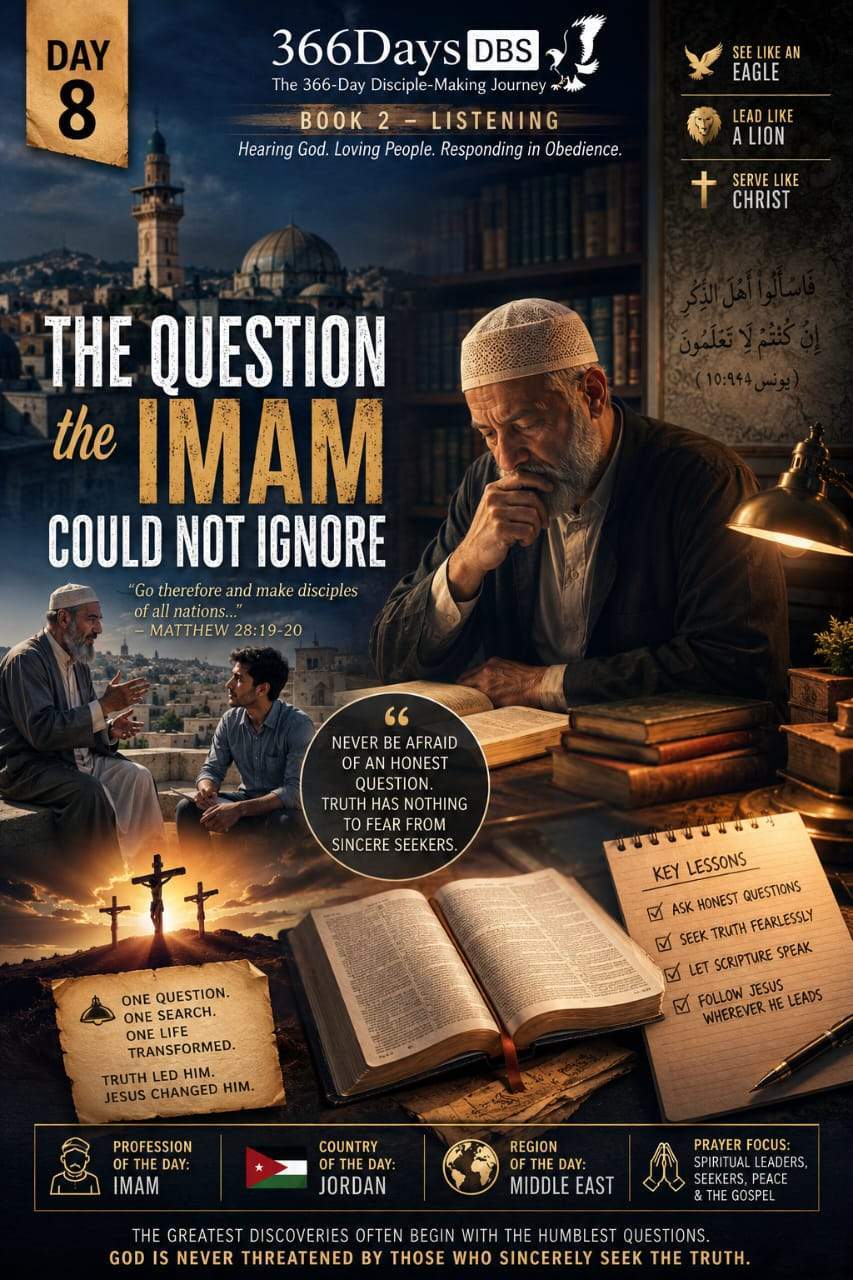
366DaysDBS: The 366-Day Disciple-Making Journey
🦅 See Like an Eagle. 🦁 Lead Like a Lion. ✝️ Serve Like Christ.
“Go therefore and make disciples of all nations…” — Matthew 28:19–20
BOOK 2 — LISTENING
Hearing God. Loving People. Responding in Obedience.
🦅 See Like an Eagle.
🦁 Lead Like a Lion.
✝️ Serve Like Christ.
🌍 Movement Home
https://movement.otakada.org
🌍 366DaysDBS
https://movement.otakada.org/366daysdbs/list
🙏 Pray4Nations
https://movement.otakada.org/pray4nations
📖 Access Ministry
https://movement.otakada.org/accessministry/list
🎓 Movement Training
https://movement.otakada.org/training
🧩 Spiritual Gifts Assessment
https://movement.otakada.org/l/p/spiritual-gift-test
🤝 Join the Movement Community
https://www.otakada.org/join-community
━━━━━━━━━━━━━━━━━━
👳 Profession of the Day: Imam
🇯🇴 Country of the Day: Jordan
🌏 Region: Middle East
🙏 Prayer Focus: Spiritual leaders, seekers after truth, peace in the Middle East, and the spread of the Gospel among unreached peoples.
❓ Big Question
What happens when an honest question refuses to leave your heart?
📖 Story
The question was asked so quietly that, at first, it seemed almost insignificant.
The afternoon prayers had ended only a few minutes earlier. Worshippers were leaving the mosque in small groups, greeting one another before disappearing into the busy streets of Amman. The courtyard, which had been filled with conversation only moments before, gradually became still as the final rays of sunlight settled across the old limestone walls that had stood there for generations.
Imam Ahmad Al-Khatib remained seated near one of the marble columns just inside the entrance. It was his habit to stay behind after every prayer. Some people came seeking advice about family matters. Others wanted guidance concerning business decisions, marriage, or the challenges of raising children. Students often asked theological questions that had emerged during their university studies.
Ahmad welcomed them all. After nearly three decades of serving as an Imam, he believed that a shepherd should never appear too busy to listen.
That afternoon, however, only one young man remained.
He waited patiently until the courtyard was almost empty before approaching. He looked to be in his early twenties, dressed simply in jeans and a light blue shirt with a small backpack hanging from one shoulder. His face carried the quiet weariness of someone who had been wrestling with thoughts far heavier than his years suggested.
Ahmad smiled warmly and invited him to sit.
“Peace be with you,” he said.
“And peace be with you,” the young man replied before introducing himself.
“My name is Yousef Khalil. I study engineering at the university.”
They exchanged a few ordinary words about family, studies, and the unusually warm weather. Nothing suggested that the conversation would become memorable. Ahmad had spoken with hundreds of students over the years, and most conversations followed familiar paths. They usually ended with encouragement, a short prayer, and a promise to meet again.
This conversation did not.
After several moments of silence, Yousef looked directly at the Imam.
“Imam Ahmad,” he began carefully, “may I ask you something that has troubled me for a very long time?”
Ahmad nodded without hesitation.
“You never need permission to ask an honest question.”
The young man lowered his eyes for a moment, gathering his thoughts. When he finally spoke, his voice remained calm, yet every word carried the weight of someone who genuinely wanted an answer rather than an argument.
“How can I know with certainty that God has forgiven my sins?”
Ahmad had heard similar questions before. His years of study had prepared him to explain repentance, mercy, prayer, and the importance of sincere devotion. He responded thoughtfully, describing God’s compassion and encouraging the young man to continue seeking Him faithfully.
Yousef listened respectfully without interrupting. When the Imam finished speaking, he thanked him sincerely. Then, after another thoughtful pause, he quietly asked a second question.
“I understand all of that, Imam. But my question is different.”
He looked up again.
“How can I know?”
For the first time in many years, Ahmad did not answer immediately.
It was not that he lacked knowledge. He had devoted most of his adult life to studying theology, teaching the Qur’an, counselling families, and helping others understand their faith. His shelves at home were lined with books collected over decades, many of them filled with his own handwritten notes. Students respected him because he rarely spoke carelessly, and fellow Imams often invited him to teach at conferences and seminars.
Yet this question settled somewhere much deeper than the intellect. It was not asking about religious practice. It was asking about certainty. The difference mattered more than Ahmad wanted to admit.
Instead of replying quickly, he asked Yousef another question.
“May I ask why this question is so important to you?”
The young man smiled faintly.
“Because if I cannot know where I stand with God while I am alive, I do not know how to live tomorrow.”
The Imam remained silent.
Not because he wished to end the conversation, but because he realised that the young man deserved more than a familiar answer. Some questions are satisfied with information. Others quietly invite both people into a deeper search for truth.
As they rose to leave, Ahmad placed a hand gently on the young man’s shoulder.
“Yousef,” he said, “thank you for asking me honestly. I would like us to continue this conversation. Give me a little time. I do not want to answer such an important question carelessly.”
The two men parted with mutual respect, but the conversation did not end there. It travelled home with the Imam, sat quietly beside him during dinner, accompanied him into his study that evening, and remained with him long after the lights of the city had disappeared into the darkness.
Before going to bed, Ahmad opened the notebook in which he had recorded questions from students over many years. On a fresh page he wrote only one sentence.
How can anyone know with certainty that God has forgiven them?
He closed the notebook, unaware that this single question was about to become the beginning of the most important journey of his life.
The following morning, Imam Ahmad Al-Khatib rose earlier than usual. The city of Amman was only beginning to awaken as the first light spread across the hills. Normally, the quiet hours before dawn were among his favourite moments of the day. They were reserved for prayer, reflection, and preparation before the responsibilities of teaching and shepherding his congregation began. Yet this morning his thoughts returned repeatedly to the same conversation.
It was not the question itself that unsettled him. Throughout nearly thirty years of ministry, he had answered countless difficult questions about faith, suffering, justice, family, and the character of God. What troubled him was the sincerity with which Yousef had asked it. The young man had not been searching for an intellectual discussion. He had been searching for certainty. Ahmad found himself wondering whether he had truly answered the question that had been asked, or merely the question he expected to hear.
Later that week, Yousef returned. Their conversation continued for almost two hours. They spoke about repentance, the mercy of God, obedience, and the hope of eternal life. Ahmad explained each subject carefully, drawing upon the teachings he had studied for decades. Yousef listened respectfully, often taking notes in a small notebook he carried everywhere. When the discussion ended, he thanked the Imam once again.
Before leaving, however, he quietly repeated the same words.
“Imam Ahmad, everything you have explained tells me what I should do. But I still do not know how I can know that God has truly forgiven me.”
The simplicity of the question made it impossible to dismiss. Ahmad promised they would continue meeting, and over the months that followed, they did exactly that. Their conversations moved beyond theology into life itself. They spoke about fear, purpose, guilt, death, justice, mercy, and the longing every human heart carries to be accepted by God. Although they often approached these subjects from different angles, the conversations were marked by mutual respect. Neither man sought to defeat the other. Both genuinely desired truth.
One evening, after Yousef had gone, Ahmad sat alone in his study surrounded by shelves filled with books collected over a lifetime. He began reviewing notes from earlier conversations with students who had asked similar questions. As he turned page after page, he realised that many people had asked about forgiveness, assurance, and the character of God. Most had accepted the answers they received. Yet he had never stopped to ask himself whether he possessed the certainty they were seeking.
The question became his quiet companion. It accompanied him while he prepared sermons, while he counselled families, and while he travelled to conferences. At unexpected moments it would return to his thoughts with surprising clarity. Whenever he prayed, he found himself adding one simple request.
“Lord, if there is more that I need to understand, do not allow my position or reputation to keep me from finding it.”
Several months later, while reading the Qur’an during one of his regular study periods, Ahmad paused over a passage he had read many times before. His eyes rested on the instruction found in Surah Yunus 10:94, where those in doubt are directed to ask those who had been reading the earlier Scriptures. He had often explained the verse to students in passing, yet on this occasion it seemed to invite a deeper consideration. If God Himself pointed people toward the earlier revelations, then surely those writings deserved careful study rather than casual familiarity.
The thought remained with him for several days before he acted upon it. Finally, he visited one of the oldest bookshops in the city, a place known for carrying religious literature from many traditions. He purchased an Arabic translation of the Torah, the Zabur, and the Injil. The books were not unfamiliar to him. He had consulted passages before while preparing lectures on comparative religion. What was different now was his purpose. He was no longer reading in order to explain someone else’s beliefs. He was reading because he wanted to understand what the earlier Scriptures actually said.
He established a simple discipline. Each evening, after completing his daily responsibilities, he spent an hour reading the earlier Scriptures alongside his existing studies. He made careful notes in the margins and compared passages whenever he encountered similar themes. The more he read, the more he noticed that the story unfolding across the pages was remarkably consistent. From Genesis onward, humanity’s deepest problem was separation from God, and throughout the Scriptures God Himself continually provided the means by which people could be restored to Him.
One name appeared again and again.
Abraham.
Ahmad found himself lingering over the account of Abraham being asked to offer his beloved son. He had always admired Abraham’s obedience, but this time another detail captured his attention. At the decisive moment, God Himself provided a substitute. The pattern stayed with him. Why was the substitute so central to the story? Why did God insist upon providing it Himself?
As the months passed, Yousef continued visiting. Sometimes they discussed what Ahmad had been reading. At other times they simply talked about life. The young student never attempted to force conclusions. Instead, he encouraged the Imam to continue searching honestly. More than once he repeated a sentence that gradually became familiar.
“Truth has nothing to fear from sincere questions.”
Those words echoed in Ahmad’s heart long after each meeting ended. He realised that genuine faith should never be threatened by honest investigation. If truth was truly from God, then careful searching could only bring a person closer to Him.
One afternoon, Yousef asked whether Ahmad would be willing to meet an elderly Arab Christian scholar who had spent much of his life studying the Scriptures in their original languages. Ahmad hesitated at first. He had participated in formal dialogues before, but those gatherings often became debates in which each side tried to defend its position. That was not what he wanted. He was no longer interested in winning arguments. He was searching for answers.
After several days of prayer and reflection, he agreed to the meeting.
The elderly scholar, whose name was Elias Haddad, welcomed him into a modest home overlooking the hills of Amman. Their first conversation lasted almost three hours. To Ahmad’s surprise, Elias spent very little time trying to persuade him of anything. Instead, he listened carefully to every question before opening the Scriptures and inviting Ahmad to read the passages for himself. There was no pressure, no argument, and no attempt to force a conclusion. Again and again, Elias simply asked, “What do you see?”
Ahmad left that evening carrying more questions than answers, yet for the first time in many months he felt an unexpected sense of hope. His search was no longer driven by uncertainty alone. It had become a genuine pursuit of truth, wherever that truth might lead.
He did not realise it then, but the journey that had begun with one student’s quiet question was slowly leading him toward the One who had called Himself the Truth.
The seasons changed almost unnoticed.
What had begun as a single conversation after afternoon prayers slowly became a journey that stretched over many months. Imam Ahmad Al-Khatib continued leading prayers, teaching students, visiting families, and serving the people who depended upon his wisdom. Outwardly, very little had changed. Inwardly, however, he had become a student once again. Every evening, after the responsibilities of the day had ended, he returned to the small wooden desk in his study where his Qur’an, the Torah, the Zabur, the Injil, notebooks, dictionaries, and commentaries now lay side by side. He was no longer reading merely to prepare lessons for others. He was searching because he had discovered that one sincere question deserved an honest answer.
His meetings with Elias Haddad became a regular rhythm. Sometimes they met in Elias’ modest home overlooking the hills of Amman. At other times they sat quietly in a small library attached to an old church where Arabic manuscripts had been preserved for generations. Their conversations rarely resembled debates. Elias never mocked Ahmad’s convictions, nor did he pressure him toward conclusions. Instead, he repeatedly invited him to read the Scriptures carefully and ask one simple question.
“If God has been revealing His plan throughout history,” Elias would often say, “do the later Scriptures complete the earlier ones, or do they contradict them? Let the Scriptures answer that question for themselves.”
Those words shaped the way Ahmad studied. Rather than reading isolated passages, he began following themes from beginning to end. The first theme that captured his attention was sacrifice. He returned to the account of Abraham offering his beloved son and lingered over the moment when God Himself provided the substitute. For years he had admired Abraham’s obedience, but now he found himself asking why God had chosen substitution rather than simply cancelling the sacrifice altogether. The question followed him into the story of the Passover, where another lamb died so that others might live. It appeared again in the sacrificial system described in the Law, where innocent blood was offered repeatedly for the sins of the people.
The pattern was impossible to ignore. Again and again, God provided what people could not provide for themselves.
One evening Elias suggested that they read Isaiah 53 together. Ahmad had encountered portions of Isaiah before, but he had never devoted sustained attention to the chapter. As they read slowly through the passage in Arabic, every sentence seemed to deepen the mystery. The Servant described there was rejected, despised, pierced, and yet willingly bore the sins of others. The language was both beautiful and unsettling. Ahmad read the chapter once, then again, and finally a third time in silence.
After several minutes he closed the book and looked at Elias.
“Who is this servant?” he asked quietly.
Elias did not answer immediately. Instead, he opened the Gospel according to John and invited Ahmad to read aloud the words spoken by John the Baptist when he first saw Jesus.
“Behold, the Lamb of God, who takes away the sin of the world.”
Ahmad stopped reading. His eyes moved slowly from the Gospel back to Isaiah and then once more to the words before him. The connection was not yet complete, but for the first time he realised that the writers of the New Testament were presenting Jesus as the fulfilment of a story that had begun centuries earlier.
Over the following weeks he continued tracing the same thread. He read the accounts of Jesus’ arrest, trial, crucifixion, and resurrection with unusual care. He noticed details he had previously overlooked: the timing of the Passover, the silence before His accusers, the words spoken from the cross, and the repeated emphasis that these events fulfilled what had been written long before. None of the passages stood alone. Each seemed to complete another piece of a much larger picture.
The greatest turning point came unexpectedly during a rainy evening nearly eighteen months after Yousef had first asked his question. Ahmad was reading Paul’s letter to the Romans. When he reached the fifth chapter, he paused over the description of God’s love demonstrated through Christ’s death for sinners. He continued reading into Hebrews, where the writer explained that the sacrifices offered year after year could never completely remove sin, but that Christ had offered Himself once for all.
Ahmad leaned back in his chair and closed his eyes. Around him, the room was completely still except for the gentle sound of rain against the window. His notebooks lay open across the desk, filled with observations collected over many months. He began turning the pages one by one. Abraham. The substitute. The Passover lamb. The sacrifices. Isaiah’s suffering servant. John calling Jesus the Lamb of God. The cross. Romans. Hebrews.
For the first time, every thread converged into a single, coherent story.
He realised that his lifelong search had never really been about religion. It had always been about reconciliation. How could a perfectly holy God remain perfectly just while extending perfect mercy to people who could never remove their own guilt? The answer was not found in human effort but in God’s own provision. Just as He had provided the substitute for Abraham, He had ultimately provided the perfect sacrifice in Jesus Christ.
Tears filled Ahmad’s eyes as he looked again at the words before him. They were no longer isolated passages from different books written across centuries. They had become one unfolding testimony to God’s redeeming plan.
He quietly left his chair and knelt beside the desk where he had spent so many evenings searching for answers. There was no audience, no choir, no preacher inviting him forward, and no public ceremony. There was only a man, the Scriptures, and the God who had patiently guided him through every honest question.
In the stillness of that room, Ahmad prayed words unlike any he had prayed before.
“Lord Jesus, I have searched for You without fully knowing that it was You I was seeking. Thank You for patiently leading me through every question and every page of Scripture. I now understand that forgiveness is not something I can earn. It is Your gift, purchased through Your sacrifice. Today I place my trust in You alone. Teach me to follow You faithfully for the rest of my life, whatever the cost.”
Nothing in the room appeared different when he stood to his feet. The rain still fell outside. The books remained open upon the desk. The city continued with its ordinary routines.
Yet everything had changed. The question that had begun his journey had finally found its answer—not merely in an explanation, but in a Person.
Several weeks later Ahmad met Yousef once again. Before the young man could speak, the former Imam smiled warmly and thanked him.
“The question you asked did not change my life,” he said gently. “It changed the direction of my search. The Scriptures led me to Christ.”
Years later, when people asked him what had convinced him, Ahmad rarely began by speaking about arguments or debates. Instead, he would quietly open his well-worn Bible and say, “Never be afraid of an honest question. Truth has nothing to fear from sincere seekers. The first question that transformed my life was not the one I was asked. It was the one I was finally willing to hear.”
✨ Kingdom Insight
Imam Ahmad’s journey did not begin because someone argued with him. It began because someone asked an honest question, and he loved God enough to admit that he did not yet possess the answer with certainty. Many people spend their lives defending positions they have never deeply examined. Ahmad chose a different path. He listened. He searched. He allowed the question to challenge his assumptions instead of silencing it.
Throughout the Bible, God has never been threatened by sincere seekers. Abraham questioned. Moses questioned. David questioned. Jeremiah questioned. Habakkuk questioned. Even the disciples asked questions that revealed their fears, doubts, and misunderstandings. Honest questions, when brought before God with humility, often become the doorway through which deeper faith is born.
Ahmad eventually discovered that Christianity is not primarily about becoming more religious. It is about becoming reconciled to God through Jesus Christ. The greatest discovery of his life was not another theological argument. It was the realization that forgiveness is not achieved by human effort but received through God’s gracious provision. The substitute provided for Abraham, the Passover lamb, the sacrifices of the Old Testament, Isaiah’s suffering servant, and the cross of Christ all tell one continuous story. God Himself provided what humanity could never provide for itself.
Listening therefore involves much more than hearing words. It requires humility, courage, and a willingness to follow truth wherever God reveals it. Many people ask questions because they want to win debates. Others ask because they genuinely long to know God. Those who seek Him with sincere hearts will never find Him unwilling to reveal Himself.
Perhaps the greatest lesson from today’s story is this: the question that transforms our lives is often not the first question we ask. It is the first question we finally become willing to hear.
🤔 Reflecting on the Story
What part of today’s story stayed with you the longest?
Which person did you identify with most: Imam Ahmad, Yousef, Elias, or someone else?
What do you think impressed you most about Ahmad’s response to Yousef’s question?
Why is it sometimes easier to defend what we already believe than to honestly examine it?
Have you ever carried a question about God that you were afraid to ask?
What qualities made Elias a trustworthy guide during Ahmad’s search?
What does today’s story teach about the relationship between humility and truth?
Is there a question you need to bring honestly before God today?
🪞 Reflecting on Scripture
Imam Ahmad’s search eventually led him to one central question: How can sinful people stand before a perfectly holy God with confidence rather than uncertainty? Remarkably, today’s Bible readings answer that question from three different perspectives while telling one unified story.
Exodus 26 describes the construction of the Tabernacle, the place where God’s holy presence dwelt among His people. Yet a heavy veil separated the Holy Place from the Most Holy Place. That curtain was a constant reminder that sin creates separation between humanity and God. No ordinary person could simply walk into God’s presence. Access required God’s provision and God’s appointed way.
Centuries later, Paul writes in 1 Corinthians 12 that all believers are brought into one body through the work of the Holy Spirit. Our acceptance before God is not based upon education, nationality, social status, religious achievement, or personal merit. It is God’s gracious work that unites us to Christ and to one another. Every believer stands on exactly the same foundation—the grace of God revealed through Jesus Christ.
Psalm 76 shifts our attention to God’s majesty. The Lord alone is glorious, righteous, and worthy of worship. Human strength cannot save us. Human wisdom cannot remove our guilt. Human religion cannot replace God’s own provision. The God who is infinitely holy is also the God who has acted in history to redeem His people.
When these passages are read together, they reveal a beautiful truth. The veil points to humanity’s separation from God. The cross of Christ opens the way into His presence. The Holy Spirit unites believers into one body. The glorious God who once seemed distant now invites us to draw near with confidence because of what Jesus has accomplished for us.
This was the discovery that transformed Ahmad’s life. He did not merely find a better explanation. He discovered that God’s plan of redemption had been unfolding throughout Scripture from the very beginning. The answer to his deepest question was not found in greater effort but in God’s greater grace.
Which part of today’s reading spoke most clearly to your heart?
What does the veil in Exodus teach you about God’s holiness?
How does Christ’s sacrifice give believers confidence before God?
Why is assurance based on God’s grace stronger than assurance based on our own performance?
Have you fully trusted Christ’s finished work, or are you still trying to earn God’s acceptance?
What truth from today’s reading gives you the greatest hope?
What specific step of obedience is God inviting you to take today?
💬 Bringing the Story and Scripture Together
Ahmad began his journey searching for certainty. Like many sincere people throughout history, he longed to know where he truly stood before God. His search eventually led him beyond arguments, traditions, and assumptions to the Scriptures themselves, where he discovered that God’s plan of salvation was not a collection of disconnected events but one unfolding story centred on Jesus Christ.
The veil in the Tabernacle, the sacrifices offered throughout the Old Testament, the words of the prophets, the ministry of John the Baptist, the death and resurrection of Christ, and the teaching of the apostles all point toward the same glorious reality. God Himself has provided the way by which sinners may be forgiven, reconciled, and welcomed into His presence. What humanity could never accomplish through its own efforts, God accomplished through His Son.
Today’s story reminds us that genuine listening is an act of humility. It requires the courage to acknowledge that we do not know everything and the willingness to follow truth wherever God reveals it. When honest questions are placed into God’s hands, He is faithful to lead sincere seekers toward Himself.
Today’s Connecting Question:
What question have you been carrying that God may be inviting you to bring honestly before Him, trusting that His truth is never threatened by sincere seekers?
✅ Commands to Obey
Love God with all your heart, soul, mind, and strength.
Seek truth with humility and an open heart.
Listen carefully before drawing conclusions.
Search the Scriptures diligently and allow God’s Word to shape your beliefs.
Follow Jesus wherever He leads, regardless of the personal cost.
Respond immediately when God reveals truth to you.
Help sincere seekers discover Christ with gentleness, patience, and respect.
Pray regularly for people who are searching for God.
🚫 Things to Avoid
Avoid allowing pride to prevent you from learning.
Avoid defending traditions above the truth of God’s Word.
Avoid rejecting honest questions because they make you uncomfortable.
Avoid relying on religious activity instead of a genuine relationship with Christ.
Avoid arguing merely to win debates rather than helping people discover truth.
Avoid assuming you have nothing more to learn from God’s Word.
Avoid ignoring the gentle conviction of the Holy Spirit.
Avoid postponing obedience after God has made His truth clear.
🗝️ Kingdom Action Step
Set aside at least thirty uninterrupted minutes today to meet with God through His Word. Ask Him to reveal any question, assumption, fear, or belief that may be preventing you from knowing Him more deeply. If you have never carefully read one of the Gospels from beginning to end, begin today with the Gospel of John and allow Jesus to speak for Himself.
If you know someone who is sincerely searching for God, do not rush to win an argument. Listen to their story, answer with gentleness, and invite them to explore the Scriptures with you. Remember that it was patient listening, not pressure, that opened Ahmad’s heart to continue his search.
🙏 Prayer
Personal
Heavenly Father, thank You for revealing Yourself through Your Son, Jesus Christ. Thank You that forgiveness is not something I must earn but a gift You freely offer through His finished work on the cross. Give me a humble heart that loves truth more than personal pride. Teach me to listen carefully to Your voice through the Scriptures, to obey what You reveal, and to follow You wherever You lead. Remove every barrier that keeps me from knowing You more deeply, and let my life increasingly reflect the character of Christ.
Family
Lord, establish Your truth within our homes. May our families become places where honest questions are welcomed, where Your Word is read faithfully, where prayer becomes a daily habit, and where every member grows in the knowledge and love of Jesus Christ. Heal misunderstandings, strengthen relationships, and help us encourage one another in our walk with You.
Middle East
Father, we lift before You the nations of the Middle East. Pour out Your Spirit upon every community, every family, and every generation. Strengthen believers who faithfully follow Christ under difficult circumstances. Give wisdom, courage, and compassion to pastors, evangelists, disciple-makers, and those serving quietly behind the scenes. Open doors for respectful conversations about Jesus, and reveal Yourself to sincere seekers through Your Word, dreams, faithful witnesses, and the transforming power of the Holy Spirit.
Prayer for Jordan 🇯🇴
Lord, we pray for Jordan and its people. Bless its leaders with wisdom, justice, and humility. Strengthen Christian communities throughout the nation and protect those who faithfully bear witness to Christ. We pray for Muslim families, students, teachers, community leaders, and religious leaders who sincerely desire to know You. As You did for many throughout history, open hearts to recognise Jesus as the promised Messiah and Saviour of the world. Let Jordan become a place where Your peace, truth, and love are increasingly known.
Prayer for the Unreached
Father, we remember the millions of unreached people across Jordan, the Middle East, Asia, Oceania, and every nation where the name of Jesus is still little known. Raise up labourers filled with wisdom, humility, compassion, and courage. Open doors that no one can shut. Prepare hearts to receive the Gospel, strengthen those who come to faith despite opposition, and establish multiplying communities of disciples who will carry the Good News to future generations until every people group has had the opportunity to hear of Christ.
📢 Daily Declaration
Today I choose truth over tradition.
I choose humility over pride.
I choose to listen before I speak.
I choose to search the Scriptures with an open heart.
I choose to follow Jesus wherever He leads me.
I will never fear honest questions because God’s truth stands forever.
I will walk in obedience to His Word.
I will love people with compassion and point them to Christ.
🦅 I will see like an eagle.
🦁 I will lead like a lion.
✝️ I will serve like Christ.
In Jesus’ name.
Amen.
📤 Share the Journey
Share today’s lesson with a pastor, missionary, disciple-maker, church leader, Bible study group, or someone who is sincerely searching for God.
Encourage them never to fear honest questions, because truth always welcomes sincere seekers.
“The greatest discoveries often begin with the humblest questions. God is never threatened by those who sincerely seek the truth, because every genuine search ultimately finds its answer in Jesus Christ.”
📊 Report Your Growth
What did God say to you through today’s story and Scripture?
What question has God been inviting you to bring honestly before Him?
What truth from today’s Bible reading strengthened your faith the most?
How will you respond in obedience before today ends?
Who will you intentionally encourage or share today’s lesson with?
What one step will you take this week to know Christ more deeply through His Word?
🌍 Connected Kingdom Resources
Grow. Train. Pray. Discover Your Calling. Stay connected with the movement.